
Procurement teams often ask whether a cleaning contractor is “certified to the standard”. It is a fair question, and the honest answer needs some unpacking: the documents most often cited are guidance on the environment inside a data center, not certifications a cleaning company holds. This page explains what the guidance covers, what cleaning can and cannot do about it, and what to ask for in a scope.
Four different things that get called “standards”
| What it is | Examples | What it means for cleaning |
|---|---|---|
| Published technical guidance | ASHRAE TC 9.9 thermal and contamination guidance for data processing environments | Describes the environmental conditions equipment is designed for, including particulate and gaseous contamination. It is guidance to the facility, not a certification scheme. |
| Formal standards | The ISO 14644 family for cleanrooms and controlled environments | Defines air cleanliness classes by particle count and how to test them. Written for cleanrooms; data centers sometimes borrow the classification language. Classification is a measured property of the room, not of a contractor. |
| Facility-specific requirements | An operator’s own cleaning specification, a client contract’s cleanliness clause, a commissioning agent’s walk-down criteria | These are the requirements that actually bind the work. They set what “clean” means for that site. |
| Contractor certifications | Training certificates, quality-management certificates held by a company | Say something about the contractor’s processes. Holding one does not make a room meet any class; not holding one does not prevent a scope from being met. |
Ashburn Data Center Cleaning does not claim certification to any of these. Where a facility specification references them, the scope is written to that specification and the facility’s own testing decides acceptance.
Dust and particulate contamination
Particulate matter in a data hall comes from outside air, people and packaging, construction, and the building itself (concrete dust, degraded ceiling tiles, filter media). Fine particles settle on surfaces and are re-entrained by airflow; coarser debris collects where air slows down, such as under the floor and on top of cabinets.
Why it matters is well documented in the ASHRAE guidance: particles accumulate on heat sinks and fan blades and reduce cooling efficiency; conductive dust (metal swarf, carbon) can bridge contacts; corrosive particulates and gases attack circuit boards over time. Cleaning deals with the settled fraction. It does not change the air filtration, the building envelope or the gaseous contamination, which are facility engineering matters.
Airflow pathways and why they shape the scope
In a raised-floor hall with underfloor supply, cooling units push air into the plenum, it rises through perforated tiles into the cold aisle, passes through the equipment, and returns at ceiling level. Every surface on that path is a place where dust is either picked up or deposited:
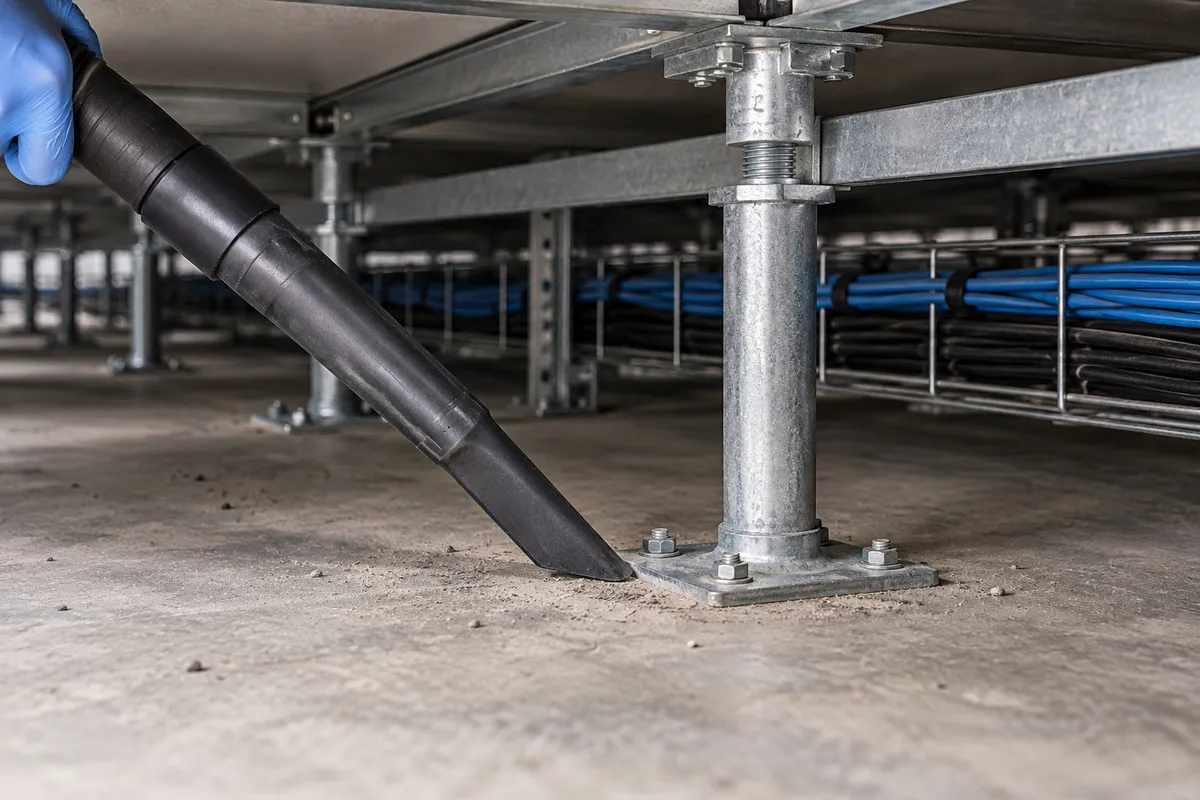
- The plenum is a supply duct. Debris on the slab, pedestals and containment can be lifted into the airstream, which is why subfloor plenum cleaning is scoped separately and treated carefully.
- Perforated tiles are the supply grilles. They are cleaned by vacuuming so the perforations stay clear and no residue is introduced.
- Cabinet intakes draw from the cold aisle. Dust on the floor and on cabinet fronts is on the way in.
- Overhead trays and cabinet tops sit in the return path. Dust accumulates there and falls when disturbed, which is why high-level cleaning is on a longer cycle but not off the list.
Halls with overhead cooling or in-row units have different paths, and the scope follows the path.
ESD precautions
Electrostatic discharge is a risk whenever people and materials move around equipment. The practical precautions in a cleaning scope are about not creating charge and not transferring it: low-lint, non-synthetic-shedding cloths; products compatible with dissipative flooring so no insulating film is left behind; no plastic sheeting dragged across floors; tools and carts that the facility has approved. Some facilities require wrist straps or grounded footwear for anyone in the hall; where they do, that is part of the method statement.
Note the distinction: a cleaning method can be chosen to respect a facility’s ESD controls. That is not the same as the contractor or the method being “ESD-safe” in any certified sense, and this site makes no such claim.
Approved materials and HEPA filtration
Two things should be written into every scope. First, a list of cleaning agents the facility has approved, or a product class with the facility’s sign-off, because the wrong agent leaves residue or damages a floor finish. Second, the filtration standard of the vacuum equipment, normally HEPA-filtered so fine particles are captured rather than exhausted back into the hall. Equipment appearance proves nothing; the specification in the method statement is what to check.
Site-specific operational procedures
The bulk of any real cleaning standard is the site’s own: badging and escorts, hours, open-tile limits, which rows may be worked over, what to do on finding water or damage, photo policy, how exceptions are reported. These belong in the method statement and the cleaning checklist, and they vary enough between sites that a generic procedure is never the right answer.
Inspection and documentation
Guidance documents assume the facility monitors its environment. The cleaning contractor’s part is to leave a record: areas covered, methods used, exceptions found. Where a facility measures particle counts, those measurements belong to the facility’s commissioning or monitoring process; a cleaning visit record is evidence of work done, not a test result.
What to ask a contractor
- Which surfaces and zones are in scope, and which are excluded?
- What products and filtration will be used, and who approves them?
- How is tile lifting controlled, and what is the open-tile limit?
- What happens when the crew finds water, damage or unlabeled cabling?
- What record is left after each visit?
- If the contractor claims a certification, which body issued it and what does it cover?
Those questions are answered in the scopes for server room cleaning, raised floor cleaning, plenum cleaning and maintenance plans, and in writing in every proposal.